Distinguish globe artichokes from Jerusalem artichokes in a search
Two foods can share the word artichoke while belonging to very different kitchen tasks. USDA’s historic raw globe-artichoke and Jerusalem-artichoke entries illustrate a name-matching problem. Read the complete reference before using its calorie figure, and keep those raw-food values separate from marinated hearts or a prepared restaurant dish.
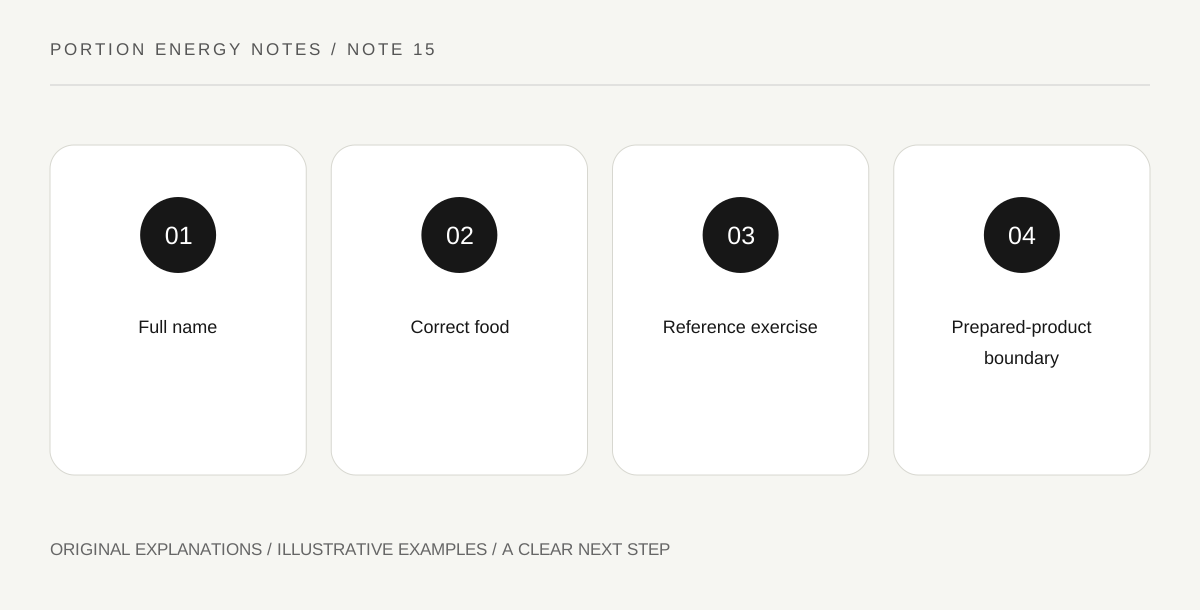
Original explanatory diagram. Read the full method and limitations below.
Keep globe or French in the description
SR Legacy record 169205 is raw globe or French artichokes at 47 kcal per 100 g. This identifies the reference food more precisely than artichoke alone. A label for prepared hearts may describe a different food form and additional ingredients. Do not assume the shortest search result is the most general correct answer. Preserve the identifying words so another reader can reconstruct which food was intended and why a similarly named result was left out.
Read Jerusalem-artichoke as a separate food
Record 169236 is raw Jerusalem-artichokes at 73 kcal per 100 g. It should not be merged with the globe entry merely because both contain the same noun. The practical task is food identification, not averaging two values until they look plausible. A shopping list, package and recipe can help establish which ingredient is actually being discussed. If that identity is uncertain, resolve it before claiming a precise result rather than letting a calculator hide a wrong food behind correct multiplication.
Use the raw references only within a raw-reference exercise
For a hypothetical 80 g amount of the globe reference, 47 times 0.8 gives 37.6 kcal. The same 80 g arithmetic example for the Jerusalem-artichoke reference gives 58.4 kcal. These are not instructions to eat either food raw or a claim about two cooked servings. They demonstrate the effect of choosing two different named entries. A recipe using another preparation needs appropriate evidence for that food rather than inheriting a raw-food number because the ingredient name was found first.
Treat prepared hearts as their own matching question
Marinated artichoke hearts, a cheese dip and plain cooked artichoke are not one interchangeable result. Use the actual prepared product information or a known formulation when appropriate. This profile does not invent how much oil remains on a drained heart or analyze an unknown restaurant dish. Its useful conclusion is narrower: full names prevent a category mistake before any portion arithmetic begins. A calorie comparison should remain a descriptive tool rather than a reason to rank vegetables or prescribe an amount for a person.
Illustrative worked example
Illustrative search correction: A reader searches artichoke and finds both globe and Jerusalem entries. They retain the complete names and choose the one that matches the fictional exercise. At 80 g, the raw globe reference yields 37.6 kcal. A jar of marinated hearts is checked separately. The example reports no cooking test, recommends no raw serving and assigns no absorption factor to the jar’s oil.
Questions that come up
Can the word artichoke alone identify the correct record?
Not reliably. The dataset contains distinct foods sharing that word. Match the complete description before calculating.
Do the raw example values describe a cooked restaurant side?
No. A prepared dish has its own ingredients and state. Use appropriate evidence rather than silently extending a raw reference.
References and scope
These sources support the factual background. Examples and exercises are original illustrative teaching material. References do not imply endorsement.
- USDA SR Legacy April 2018 CSV archive — Historic energy nutrient 1008 values per 100 g edible material, used by the local factual food reference.
- USDA SR Legacy 169205: Artichokes, (globe or french), raw — Historic reference: 47.0 kcal per 100 g; exact description Artichokes, (globe or french), raw. Values verified from downloaded USDA archive, not a current product assay.
- USDA SR Legacy 169236: Jerusalem-artichokes, raw — Historic reference: 73.0 kcal per 100 g; exact description Jerusalem-artichokes, raw. Values verified from downloaded USDA archive, not a current product assay.