Read avocado variety as a reference detail rather than a quality score
An avocado search can return an all-varieties reference and entries named for California or Florida. Those names should remain attached to the calorie figures. USDA’s historic values help explain how a database can describe several reference foods without declaring one avocado universally better or predicting the exact composition of fruit in a shopper’s hand.
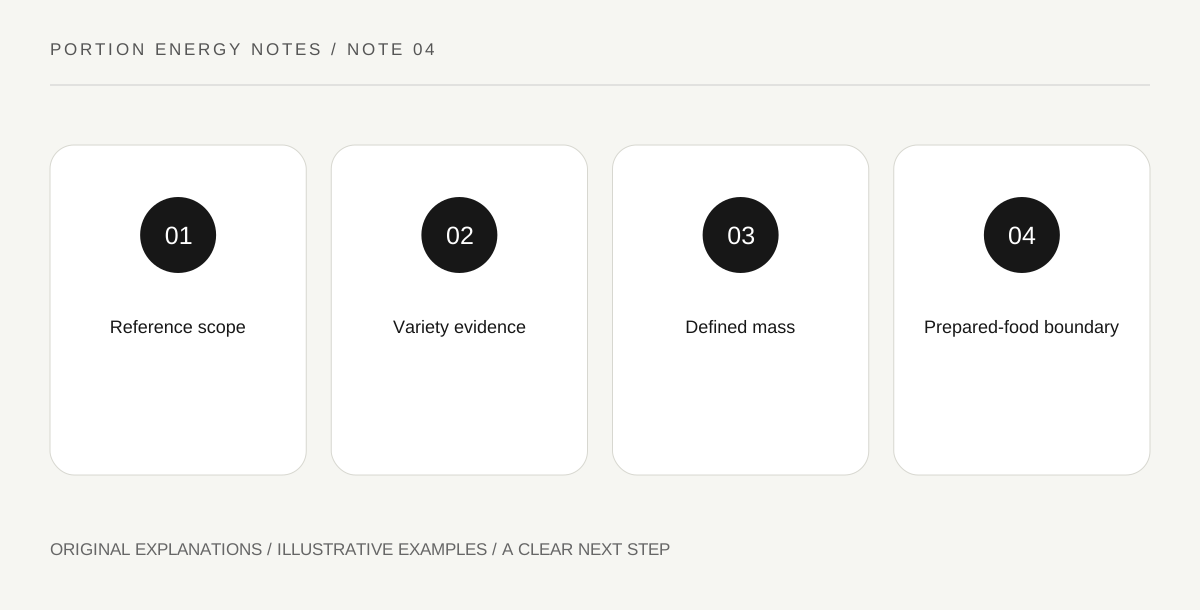
Original explanatory diagram. Read the full method and limitations below.
Start with the general entry’s scope
SR Legacy record 171705 is raw avocado, all commercial varieties, at 160 kcal per 100 g. All commercial varieties describes that reference’s scope; it is not a promise that every avocado contains exactly the same energy. Keep the full wording when using the value. A short note saying avocado 160 can be convenient, but it hides why the input was chosen and encourages later comparisons to treat a general reference as a laboratory measurement of a particular fruit.
Keep the named entries separate
Record 171706 is raw California avocado at 167 kcal per 100 g, while record 171707 is raw Florida avocado at 120 kcal per 100 g. These historical descriptions are not a lookup by where a supermarket happens to be located. Do not assign a Florida entry because the fruit was purchased in Florida or assume the package’s packing location proves its reference category. When the actual identity is unclear, use an appropriately scoped general estimate and name the uncertainty rather than inventing variety information.
Work one transparent example
For an illustrative 75 g amount matching the general 160 kcal reference, the calculation is 160 multiplied by 0.75, giving 120 kcal. This is a food-mass calculation based on the selected description. It is not a recommendation to eat 75 g, an estimate for 75 g including packaging or a statement that a whole avocado has that value. Keep the actual material and example weight clear. A specific record can make arithmetic reproducible while still leaving natural variation and matching limitations visible.
Avoid extending the fruit entry to every avocado food
Avocado oil, guacamole and a restaurant avocado spread are different reference objects. A recognizable green color or an avocado picture does not establish that the raw-fruit entry covers them. Choose evidence for the actual food or a known formulation. Energy alone also does not answer taste, ripeness, adequacy or personal health questions. The useful outcome is a descriptive comparison that helps identify a food, not a ranking that turns the lowest historical value into the best purchasing choice for everyone.
Illustrative worked example
Illustrative search note: A shopper sees general, California and Florida avocado results. They do not infer variety from the store’s address. For a fictional exercise using the general entry, 75 g gives 120 kcal, and the record ID remains in the note. A separately purchased prepared guacamole stays outside that calculation. No claim is made that the shopper’s fruit was measured or that the example quantity is an ideal portion.
Questions that come up
Does 160 kcal describe a whole avocado?
No. Here it is the historic reference per 100 g of the described food. A whole-fruit claim would need its own defined amount and material.
Is the lowest variety entry automatically the best choice?
No. This is food identification and reference arithmetic, not a health ranking or individualized purchasing prescription.
References and scope
These sources support the factual background. Examples and exercises are original illustrative teaching material. References do not imply endorsement.
- USDA SR Legacy April 2018 CSV archive — Historic energy nutrient 1008 values per 100 g edible material, used by the local factual food reference.
- USDA SR Legacy 171705: Avocados, raw, all commercial varieties — Historic reference: 160.0 kcal per 100 g; exact description Avocados, raw, all commercial varieties. Values verified from downloaded USDA archive, not a current product assay.
- USDA SR Legacy 171706: Avocados, raw, California — Historic reference: 167.0 kcal per 100 g; exact description Avocados, raw, California. Values verified from downloaded USDA archive, not a current product assay.
- USDA SR Legacy 171707: Avocados, raw, Florida — Historic reference: 120.0 kcal per 100 g; exact description Avocados, raw, Florida. Values verified from downloaded USDA archive, not a current product assay.