Compare popcorn by preparation rather than the size of the bowl
Popcorn can occupy a large space while its food mass remains modest, and added ingredients create different products. USDA’s historic air-popped and home oil-popped entries offer a concrete comparison. Use their complete descriptions without treating a cinema bucket, caramel-coated snack and plain bowl as interchangeable reference objects.
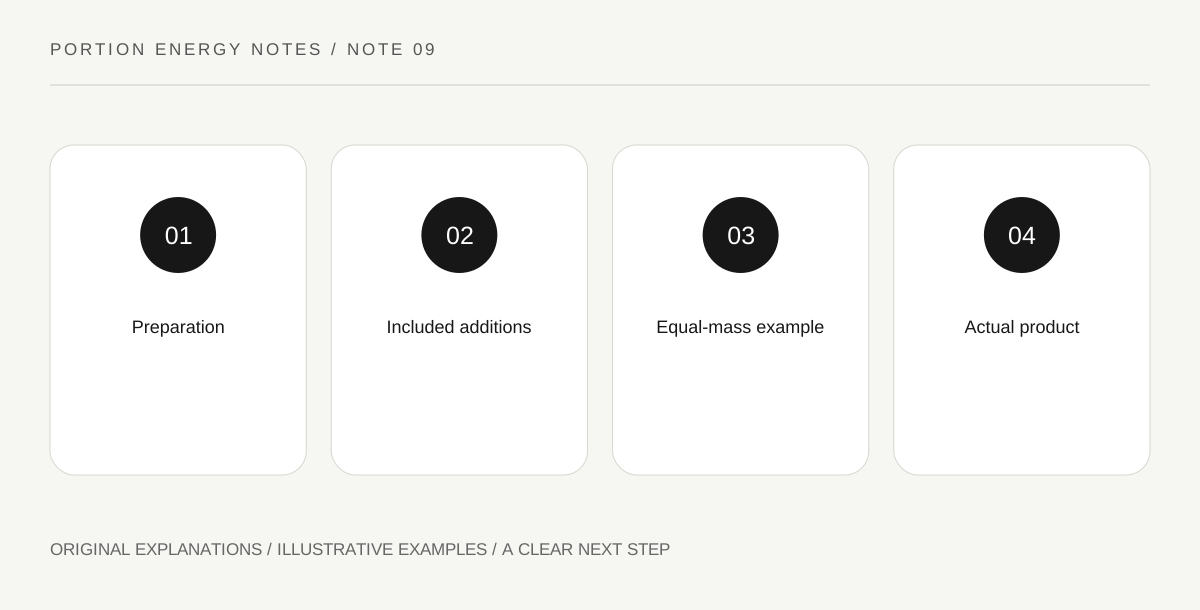
Original explanatory diagram. Read the full method and limitations below.
Keep the preparation words with the number
SR Legacy record 167959 is air-popped popcorn at 387 kcal per 100 g. Record 169861 is home-prepared oil-popped unsalted popcorn at 500 kcal per 100 g. The latter describes a prepared reference that already includes its cooking formulation. Do not add an invented oil allowance to that number as though it described plain kernels. Conversely, a separate butter topping is not automatically included just because the selected record has a higher energy value.
Describe the actual snack before measuring space
An unpopped kernel bag, a plain popped snack and a coated product differ. A large bowl does not identify which one is present. Keep the product or preparation description in the note before using a cup-based impression. The original observation task is to notice how much the snack’s visible volume depends on its shape and air spaces. Do not compress or crush food to force it into a remembered serving volume and then claim that the resulting amount is a universal bowl.
Use equal mass only for a defined reference question
At a hypothetical 20 g of each selected food, the air-popped reference gives 77.4 kcal and the home oil-popped reference gives 100 kcal. These are equal-mass arithmetic comparisons of historic inputs. They do not establish that two equal-size bowls have equal mass or that the particular oil-popped snack in your home matches the reference. The 20 g example is not a serving recommendation. Keep the question visible: comparing two record values at one stated mass, rather than choosing a diet limit.
Keep additions and current products identifiable
Caramel, cheese flavoring and other coatings can create entirely different products. For a current package, use its own relevant information instead of borrowing whichever popcorn reference gives the preferred result. If making a known recipe, use a coherent formulation estimate and avoid counting included oil twice. A practical snack description can remain approximate when the preparation is unknown. The calorie figure does not decide whether the snack is enjoyable, whether a person needs more food or what every movie night should contain.
Illustrative worked example
Illustrative snack comparison: Two bowls look similar in volume, but the reader does not assume their mass or preparation is identical. A separate worksheet uses 20 g of the historic air-popped entry for 77.4 kcal and 20 g of the home oil-popped entry for 100 kcal. A cheese-coated packaged snack is left outside that pair and checked using its own information. No actual bowl was analyzed or prescribed.
Questions that come up
Can the oil-popped entry describe caramel corn?
Not automatically. A coating changes the product. Use the actual package or a suitable complete reference.
Does the example prescribe 20 g for a snack?
No. It is a chosen arithmetic amount. It does not establish an appropriate serving or personal intake target.
References and scope
These sources support the factual background. Examples and exercises are original illustrative teaching material. References do not imply endorsement.
- USDA SR Legacy April 2018 CSV archive — Historic energy nutrient 1008 values per 100 g edible material, used by the local factual food reference.
- USDA SR Legacy 167959: Snacks, popcorn, air-popped — Historic reference: 387.0 kcal per 100 g; exact description Snacks, popcorn, air-popped. Values verified from downloaded USDA archive, not a current product assay.
- USDA SR Legacy 169861: Snacks, popcorn, home-prepared, oil-popped, unsalted — Historic reference: 500.0 kcal per 100 g; exact description Snacks, popcorn, home-prepared, oil-popped, unsalted. Values verified from downloaded USDA archive, not a current product assay.