Read dark-chocolate cacao bands without assuming a calorie shortcut
A higher cacao percentage does not automatically mean a lower calorie value. USDA’s historic dark-chocolate records provide a useful concrete example. Read the percentage band and energy together, then keep current bar formulations separate from the reference rather than turning a front-of-pack number into a universal nutrition rule.
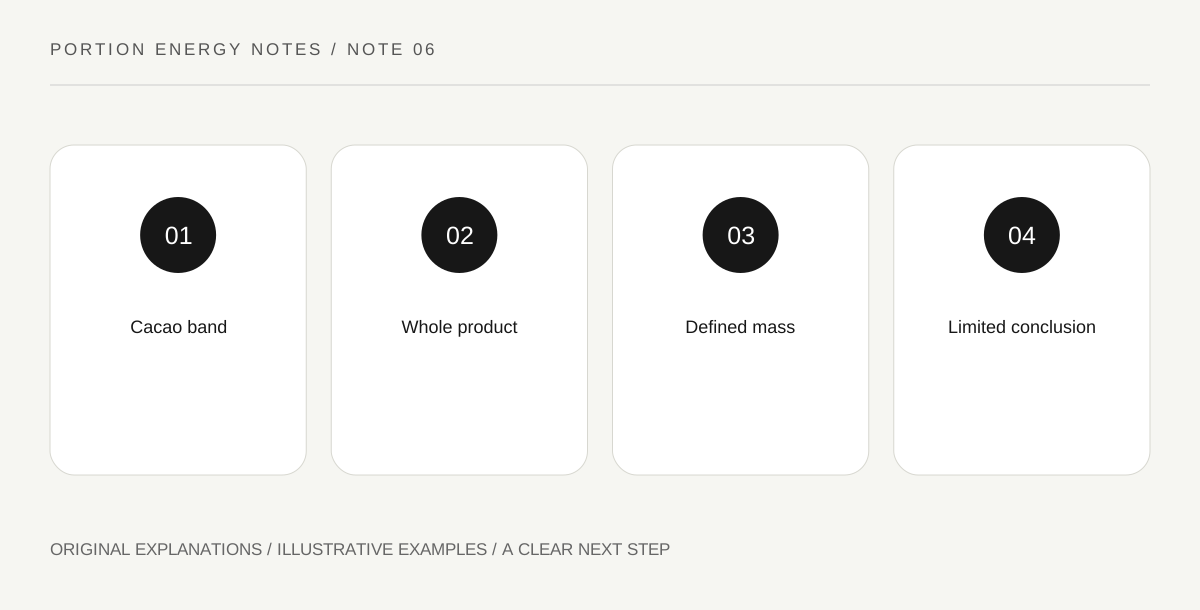
Original explanatory diagram. Read the full method and limitations below.
Keep the three bands distinct
SR Legacy record 170271 describes dark chocolate with 45–59% cacao solids at 546 kcal per 100 g. Record 170272 describes 60–69% at 579 kcal per 100 g, and record 170273 describes 70–85% at 598 kcal per 100 g. These are three historical reference categories, not a continuous equation for every percentage between them. Do not interpolate an exact value for a 73% bar simply because it falls within a named band. Its own current product information is the more specific source for that bar.
Separate cacao percentage from the whole formulation
The front percentage describes one aspect of a product. It does not independently tell you the proportions or energy contributions of every other ingredient. A useful note keeps the actual bar identity and full ingredient information with the number. Filled chocolate, a nut-studded bar and a plain bar are different products even if each says dark. Avoid treating the shared adjective as permission to transfer the plain reference to an entire confection with a separate filling or coating.
Scale a small known mass transparently
For a hypothetical 20 g amount matching the 70–85% reference, 598 times 0.2 gives 119.6 kcal. The same example weight from the 45–59% reference gives 109.2 kcal. The 10.4 kcal arithmetic difference belongs to those inputs and that mass. It is not a claim about two actual bars that have not been identified, and it does not prescribe 20 g as a serving. Retain sensible reference uncertainty rather than interpreting the decimal as a laboratory result for a particular square.
Use the comparison for the question it answers
This example shows why cacao percentage alone is insufficient for calorie inference. It does not rank chocolate by healthfulness or establish that the higher reference should be avoided. Taste, price, allergy needs and the role of the food remain separate decisions. If someone asks about sugar, read the relevant sugar information instead of assuming energy answers that question. A descriptive reference is most useful when it stops short of converting one number into advice about what everybody should buy or eat.
Illustrative worked example
Illustrative bar comparison: A shopper compares two current dark bars and reads each label instead of assigning the USDA band value automatically. Separately, an arithmetic exercise uses 20 g of record 170273 to produce 119.6 kcal. The shopper does not infer that a higher cacao percentage guarantees fewer calories. The fictional example supplies no recommended amount, antioxidant claim, medical benefit or measured result for either actual product.
Questions that come up
Can I calculate an exact 73% value by interpolation?
Not from these category references alone. Use the actual product information for a specific bar.
Does the higher energy reference mean the chocolate is unhealthy?
That conclusion does not follow from one energy value. This profile identifies foods and demonstrates arithmetic, without ranking individual diets.
References and scope
These sources support the factual background. Examples and exercises are original illustrative teaching material. References do not imply endorsement.
- USDA SR Legacy April 2018 CSV archive — Historic energy nutrient 1008 values per 100 g edible material, used by the local factual food reference.
- USDA SR Legacy 170271: Chocolate, dark, 45- 59% cacao solids — Historic reference: 546.0 kcal per 100 g; exact description Chocolate, dark, 45- 59% cacao solids. Values verified from downloaded USDA archive, not a current product assay.
- USDA SR Legacy 170272: Chocolate, dark, 60-69% cacao solids — Historic reference: 579.0 kcal per 100 g; exact description Chocolate, dark, 60-69% cacao solids. Values verified from downloaded USDA archive, not a current product assay.
- USDA SR Legacy 170273: Chocolate, dark, 70-85% cacao solids — Historic reference: 598.0 kcal per 100 g; exact description Chocolate, dark, 70-85% cacao solids. Values verified from downloaded USDA archive, not a current product assay.