Distinguish unsweetened cocoa powder from hot-cocoa mix
Cocoa powder and a drink mix can look similar in a spoon while serving different preparation tasks. USDA’s historic entries give each a specific reference. Read the complete description before calculating, and keep a powder ingredient separate from a finished drink with its chosen liquid and any other additions.
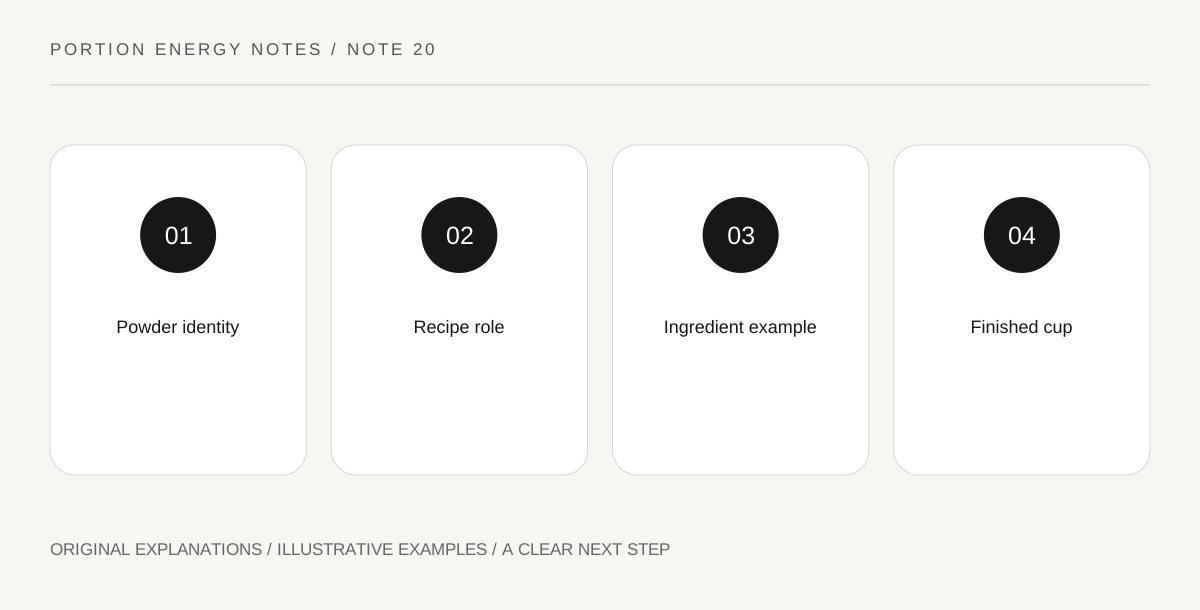
Original explanatory diagram. Read the full method and limitations below.
Read unsweetened as part of the cocoa entry
SR Legacy record 169593 is dry unsweetened cocoa powder at 228 kcal per 100 g. Record 169594 is dry unsweetened cocoa processed with alkali at 220 kcal per 100 g. These identify two specific historic reference foods. The alkali descriptor is not a calorie-reduction promise or permission to substitute powders in every baking formula. A recipe can depend on ingredient characteristics beyond energy. Keep the actual powder and the recipe’s requirements visible rather than choosing solely by which number is smaller.
Give hot-cocoa mix its own identity
Record 174122 is powdered cocoa mix at 398 kcal per 100 g. It describes a prepared mixture, not plain cocoa plus an unspecified future sweetener. A current mix can differ, so its own product information may be more relevant. Read the actual ingredient list for dietary or allergy requirements rather than assuming the brown powder is only cocoa. A no-added-sugar or another marketing claim likewise needs its own product-specific context; it cannot be inferred from the plain unsweetened-cocoa entry.
Calculate the powder contribution at a stated amount
For an illustrative 8 g of the 228 kcal unsweetened reference, 228 times 0.08 gives 18.24 kcal. For 8 g of the 398 kcal mix reference, the result is 31.84 kcal. These are equal-mass powder examples. They do not establish equivalent sweetness, flavor, drink volume or recipe performance, and 8 g is not a recommended serving. Do not call the two results equal-strength hot drinks without evidence about the products and actual preparation. The arithmetic compares only the specified powder inputs.
Keep the finished cup as a separate object
Milk or another beverage, sweetener and toppings can change the complete drink. A product label may already provide information for a specified prepared version, so read whether its value describes dry mix or the finished drink before adding components again. Keep the chosen liquid explicit. This profile does not prescribe a lower-energy drink or claim a health effect from cocoa. It helps a reader distinguish an ingredient calculation from a complete beverage estimate and acknowledge when a café’s formulation is unknown.
Illustrative worked example
Illustrative drink note: A cook identifies plain unsweetened cocoa and calculates 18.24 kcal for a fictional 8 g ingredient amount. The chosen beverage base remains a separate known component. For another product whose information already describes a prepared cup, the cook avoids adding that same base twice. The scenario does not claim equal flavor between powders, analyze a café drink or recommend how much cocoa someone should use.
Questions that come up
Can a cocoa-mix value describe plain unsweetened cocoa?
No. They are different reference foods. Match the actual powder or current product information.
Does a prepared-cup value need the stated milk added again?
Check its scope. If that milk is already included in the specified prepared version, adding it again would double count it.
References and scope
These sources support the factual background. Examples and exercises are original illustrative teaching material. References do not imply endorsement.
- USDA SR Legacy April 2018 CSV archive — Historic energy nutrient 1008 values per 100 g edible material, used by the local factual food reference.
- USDA SR Legacy 169593: Cocoa, dry powder, unsweetened — Historic reference: 228.0 kcal per 100 g; exact description Cocoa, dry powder, unsweetened. Values verified from downloaded USDA archive, not a current product assay.
- USDA SR Legacy 169594: Cocoa, dry powder, unsweetened, processed with alkali — Historic reference: 220.0 kcal per 100 g; exact description Cocoa, dry powder, unsweetened, processed with alkali. Values verified from downloaded USDA archive, not a current product assay.
- USDA SR Legacy 174122: Beverages, Cocoa mix, powder — Historic reference: 398.0 kcal per 100 g; exact description Beverages, Cocoa mix, powder. Values verified from downloaded USDA archive, not a current product assay.