Identify green boiled plantain separately from plantain chips
Plantain can appear as a boiled food, a baked accompaniment or a packaged crisp snack. Ripeness and preparation words make those different reference objects. USDA’s historic green-boiled and salted-chip entries offer a concrete comparison that should preserve the actual food’s identity rather than declaring one number the calorie value of plantain everywhere.
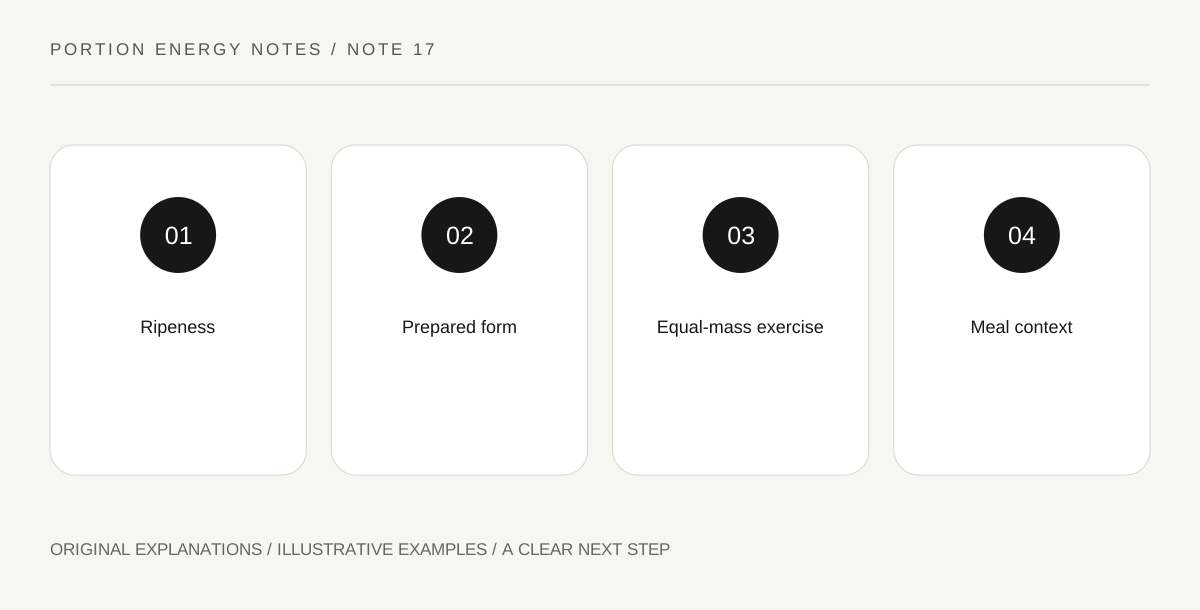
Original explanatory diagram. Read the full method and limitations below.
Read green and boiled together
SR Legacy record 168216 is green plantains, boiled, at 121 kcal per 100 g. Both descriptors matter. A yellow baked plantain or a fried restaurant preparation is not automatically the same item. Keep the actual form on the cooking or reference note. The entry describes food composition, not a full cooking method or a judgment that the food is suitable for a particular person. Use appropriate preparation instructions independently when making the ingredient in a kitchen.
Treat chips as a finished snack
Record 173142 is salted plantain chips at 531 kcal per 100 g. This is a prepared snack reference, not a plain green-plantain value with a guessed oil amount missing. Do not add an invented cooking-oil absorption estimate to a complete chip entry. For a current package, use its own relevant information when available. A chip with a different coating or formulation can differ from the historic reference even if its shape and color look familiar.
Make the example’s comparison question explicit
At a hypothetical 30 g, the boiled reference gives 36.3 kcal and the chip reference gives 159.3 kcal. This equal-mass exercise compares named historic inputs. It does not imply that 30 g is an equivalent meal role for both foods or an appropriate serving. A boiled accompaniment and a crisp snack occupy different places in eating. Avoid turning the arithmetic into a recommendation that a person should replace their planned dinner component with the same small mass of another food.
Read the complete meal instead of moralizing the snack
A prepared plantain dish may include other foods, while a packaged chip reference may already describe its finished formulation. Keep the calculation scope coherent. Energy alone does not decide whether the food is allowed, whether someone needs more food or how a culturally familiar meal should be altered. A useful reference helps a reader identify a product and understand a calculation. It should not claim an exact result for an unknown restaurant preparation or transform a single comparison into a universal diet rule.
Illustrative worked example
Illustrative product distinction: A reader keeps a home meal’s boiled green plantain separate from a bag of salted chips. In a fictional equal-mass exercise, 30 g of the selected records gives 36.3 kcal and 159.3 kcal. They use current package information for the actual snack rather than assuming it was analyzed by the historic record. No serving amount, oil-absorption factor or rule to eliminate either food is supplied.
Questions that come up
Does the boiled-green value cover yellow baked plantain?
Not automatically. The descriptors differ. Match the actual food rather than using plantain as a complete reference name.
Should I add guessed oil on top of the chip value?
No. A complete prepared-chip reference already has its own formulation. Avoid adding an unmeasured component twice.
References and scope
These sources support the factual background. Examples and exercises are original illustrative teaching material. References do not imply endorsement.
- USDA SR Legacy April 2018 CSV archive — Historic energy nutrient 1008 values per 100 g edible material, used by the local factual food reference.
- USDA SR Legacy 168216: Plantains, green, boiled — Historic reference: 121.0 kcal per 100 g; exact description Plantains, green, boiled. Values verified from downloaded USDA archive, not a current product assay.
- USDA SR Legacy 173142: Snacks, plantain chips, salted — Historic reference: 531.0 kcal per 100 g; exact description Snacks, plantain chips, salted. Values verified from downloaded USDA archive, not a current product assay.