Keep canned waterchestnuts separate from bamboo shoots in a mixed dish
Waterchestnuts and bamboo shoots can both appear as pale crisp pieces in a stir-fry, but they are different ingredients. USDA’s historic canned entries also use different material descriptions. Read those details before assigning a number to an unidentified mixed vegetable component, and keep the reference separate from the complete cooked dish.
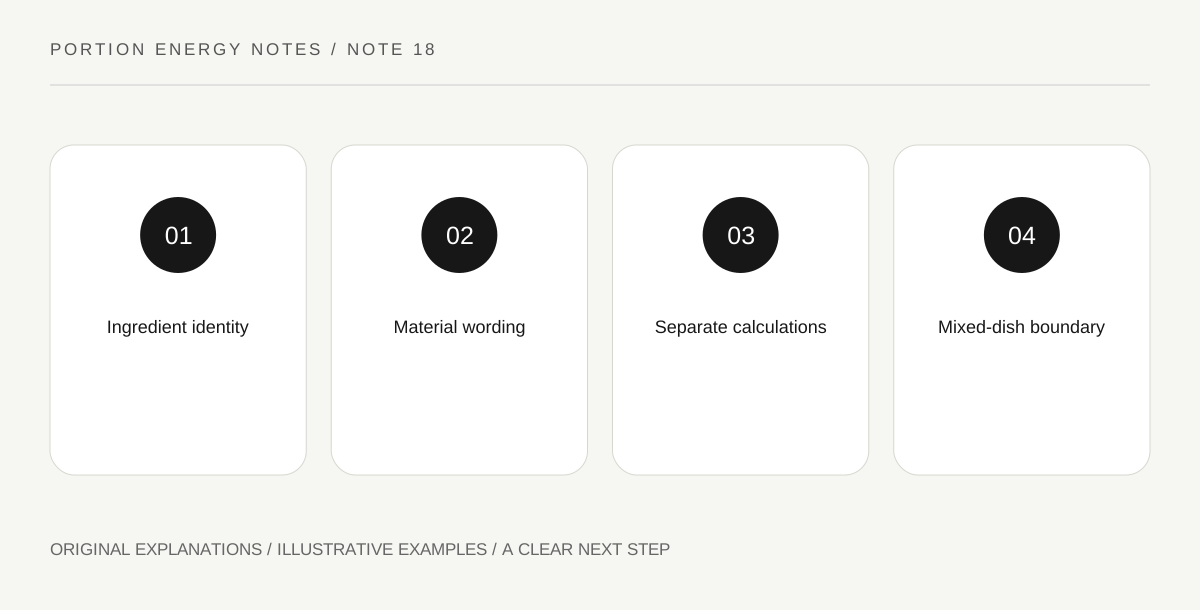
Original explanatory diagram. Read the full method and limitations below.
Identify the waterchestnut entry precisely
SR Legacy record 170067 is Chinese canned waterchestnuts, solids and liquids, at 50 kcal per 100 g. The material wording remains part of the reference. A drained slice or a dish in sauce may not match that exact scope. Do not create a hidden correction based on how wet the pieces appear. If the available source does not match the actual material, name the limitation instead of letting a precise multiplication imply that the match has been established.
Read bamboo shoots as another food
Record 169212 is canned bamboo shoots, drained solids, at 19 kcal per 100 g. It is not a synonym for waterchestnuts, and its drained-solids wording differs from the selected waterchestnut entry. A visual guess from a small photograph cannot establish either identity reliably. The original shopping task is to retain the can label or ingredient list. That evidence is more useful than a color description when another cook needs to reconstruct which vegetable entered a pan.
Use two examples without pretending they are identical conditions
For a fictional 60 g amount matching the stated waterchestnut record, 50 times 0.6 gives 30 kcal. For 60 g matching the canned drained bamboo-shoot record, 19 times 0.6 gives 11.4 kcal. These are calculations for two different named reference materials. Their difference should not be sold as a controlled experiment because the record scopes differ. Neither 60 g amount is a recommended serving. Keep the descriptions beside the results so readers can see exactly what the arithmetic does and does not compare.
Keep sauce and other ingredients outside a plain-food assumption
A stir-fry can contain both vegetables along with protein foods, starch, sauce and cooking ingredients. A plain canned reference cannot describe the entire dish by itself. Use an appropriate complete-food source or known formulation if that is the actual question. Food names also do not establish an individual allergy decision; read relevant actual product information. The practical result can be a better ingredient note and a clearly scoped estimate rather than a falsely exact total for a plate whose component identities remain unknown.
Illustrative worked example
Illustrative kitchen handover: One adult labels two prepared containers with their actual can names instead of calling both crisp vegetables. A separate worksheet calculates 30 kcal for 60 g of the selected waterchestnut material and 11.4 kcal for 60 g of the specified bamboo shoots. The scenario preserves their different record scopes and does not analyze an unknown stir-fry or prescribe an amount of either ingredient.
Questions that come up
Can pale crisp pieces be identified from calories?
No. The food must be identified before choosing an energy reference. A number cannot resolve an unknown ingredient’s identity.
Do these entries cover a complete stir-fry?
No. They describe specific canned foods. A finished mixed dish has additional ingredients and its own reference scope.
References and scope
These sources support the factual background. Examples and exercises are original illustrative teaching material. References do not imply endorsement.
- USDA SR Legacy April 2018 CSV archive — Historic energy nutrient 1008 values per 100 g edible material, used by the local factual food reference.
- USDA SR Legacy 170067: Waterchestnuts, chinese, canned, solids and liquids — Historic reference: 50.0 kcal per 100 g; exact description Waterchestnuts, chinese, canned, solids and liquids. Values verified from downloaded USDA archive, not a current product assay.
- USDA SR Legacy 169212: Bamboo shoots, canned, drained solids — Historic reference: 19.0 kcal per 100 g; exact description Bamboo shoots, canned, drained solids. Values verified from downloaded USDA archive, not a current product assay.