Use date variety without inventing a universal per-date weight
A date count is familiar, but a Medjool date and a Deglet Noor date should not inherit one assumed piece weight. USDA’s historic variety entries have similar energy per 100 g while individual pieces can differ. Keep variety and actual amount separate so the calculation answers a defined question rather than relying on a memorized per-fruit shortcut.
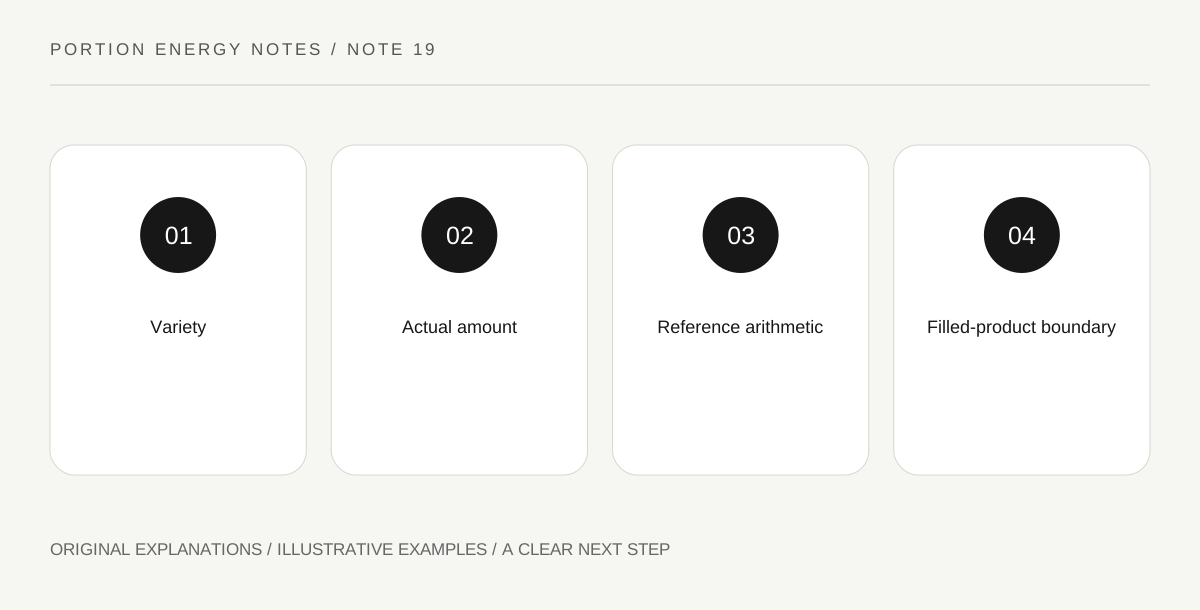
Original explanatory diagram. Read the full method and limitations below.
Keep the Medjool reference named
SR Legacy record 168191 is Medjool dates at 277 kcal per 100 g. The value belongs to that food description, not a universal date-shaped portion. A filled date, chocolate-coated date or date bar is a different product. Retain its formulation or current package information when available. A photograph showing one fruit can conceal both size and added ingredients, so it should not be treated as enough evidence to assign a precise energy result.
Give Deglet Noor its own entry
Record 171726 is Deglet Noor dates at 282 kcal per 100 g. The 5 kcal per 100 g arithmetic difference from the selected Medjool record is small relative to the difference that an unknown piece mass can introduce. This does not establish a statistical result or prove all dates are nutritionally interchangeable. It simply explains why choosing a variety label cannot supply the amount of food. Avoid treating a higher per 100 g input as a universal per-piece ranking when pieces have not been defined.
Compare a known example mass rather than an imagined piece
For a hypothetical 24 g amount matching the Medjool reference, 277 times 0.24 gives 66.48 kcal. The same 24 g arithmetic amount using Deglet Noor gives 67.68 kcal. These are equal-mass reference examples, not claims that one date weighs 24 g or that either amount is an appropriate serving. Keep the intended edible food material clear. If the actual information provides only a count and no useful weight context, preserve that uncertainty instead of borrowing a large-date assumption for every small fruit.
Treat filled snacks as their own formulation
A nut filling, dairy filling or chocolate coating adds a product question that the plain-date reference cannot resolve. Use a complete actual-product value or a coherent known-ingredient calculation, avoiding double counting. Energy cannot establish allergy suitability or a personal need to limit fruit. A reference note can be useful without creating a rule that one variety is good and another bad. Its job is to preserve identity and amount so the result can be understood and appropriately limited.
Illustrative worked example
Illustrative fruit comparison: A reader sees two date varieties and keeps the per 100 g references separate from piece counts. For a fictional 24 g arithmetic exercise, the results are 66.48 kcal and 67.68 kcal. An almond-filled packaged date is checked as a complete product. The scenario neither claims that a date universally weighs 24 g nor recommends a fruit amount, and it does not infer the filling’s mass from a photograph.
Questions that come up
Does the example mean one Medjool date always has 66.48 kcal?
No. The example uses a hypothetical 24 g amount. A per-piece claim needs evidence about the actual piece and material.
Can a plain-date value describe a chocolate-coated date?
Not as the whole product. Use appropriate complete-product information or a known formulation with clear scope.
References and scope
These sources support the factual background. Examples and exercises are original illustrative teaching material. References do not imply endorsement.
- USDA SR Legacy April 2018 CSV archive — Historic energy nutrient 1008 values per 100 g edible material, used by the local factual food reference.
- USDA SR Legacy 168191: Dates, medjool — Historic reference: 277.0 kcal per 100 g; exact description Dates, medjool. Values verified from downloaded USDA archive, not a current product assay.
- USDA SR Legacy 171726: Dates, deglet noor — Historic reference: 282.0 kcal per 100 g; exact description Dates, deglet noor. Values verified from downloaded USDA archive, not a current product assay.