Distinguish canned coconut milk from a coconut beverage
Coconut milk can name a cooking ingredient or a beverage intended for pouring into a glass. The shared words do not establish identical composition or a useful one-for-one calorie reference. USDA’s historic entries make the distinction explicit, allowing a comparison that starts with intended food form instead of the largest printed noun.
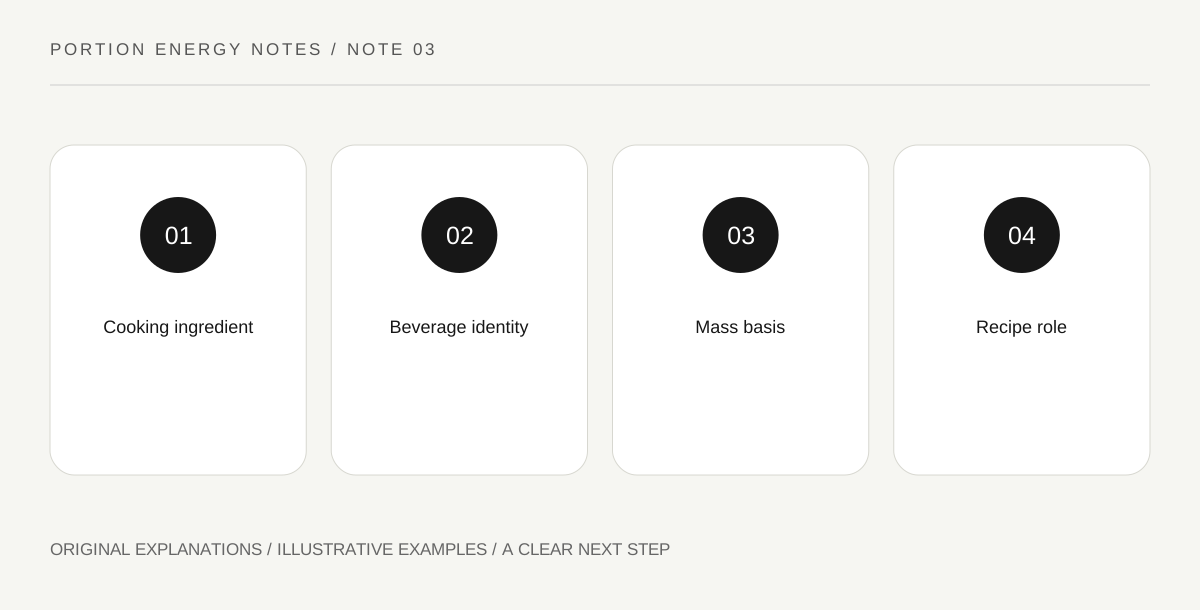
Original explanatory diagram. Read the full method and limitations below.
Read the complete canned entry
SR Legacy record 170173 describes canned coconut milk as liquid expressed from grated coconut meat and water, at 197 kcal per 100 g. Keep canned and that preparation description with the number. It does not describe coconut water, coconut oil or every modern light coconut product. A search result shortened to coconut can therefore hide the exact information needed to choose a reference. Save the complete wording when recording an ingredient for later recipe work.
Read the beverage as a different food
Record 174116 is a sweetened coconut-milk beverage fortified with calcium and vitamins A, B12 and D2, at 31 kcal per 100 g. That is a specific beverage description. Do not extend it to unsweetened drinks, current brands or the canned cooking ingredient merely because the package uses coconut milk. The fortification wording helps identify the record, but this profile does not calculate those nutrients. A value for energy cannot prove that another beverage provides the same vitamins or any particular protein amount.
Keep grams separate from a volume assumption
For a hypothetical 50 g quantity of the canned reference, 197 times 0.5 gives 98.5 kcal. The same 50 g example of the beverage reference gives 15.5 kcal. Both use food mass, because those are the selected dataset units. Do not silently rewrite 50 g as 50 mL unless the actual product information supplies an appropriate relationship. A measuring cup and a scale answer different questions. The arithmetic demonstrates these two records, not a serving prescription or a validated cooking substitution.
Choose by the recipe’s job before comparing numbers
A recipe may need a particular richness, body or product form. Replacing its ingredient with a much more dilute beverage changes more than the energy input. Use an appropriate complete recipe if changing forms rather than assuming the lowest database number will preserve the dish. For the actual current product, read its label and ingredients. The reference should explain the food being used, not encourage a substitution that makes the cooking instructions and calculation describe different ingredients.
Illustrative worked example
Illustrative shopping check: A cook notices that a carton beverage and a canned ingredient share coconut-milk wording. They retain the recipe’s intended canned form and use the beverage only in a separate comparison exercise. The 50 g calculations are 98.5 kcal and 15.5 kcal for the named historic records. The scenario does not claim those are the values of two unexamined store products or recommend a 50 g amount for any person.
Questions that come up
Is coconut water the same record?
No. It is a different food. Search and match its own complete description rather than using a coconut-milk value.
Does the lower number establish a suitable recipe replacement?
No. Food form and cooking role also matter. A beverage may not perform the job of a canned cooking ingredient.
References and scope
These sources support the factual background. Examples and exercises are original illustrative teaching material. References do not imply endorsement.
- USDA SR Legacy April 2018 CSV archive — Historic energy nutrient 1008 values per 100 g edible material, used by the local factual food reference.
- USDA SR Legacy 170173: Nuts, coconut milk, canned (liquid expressed from grated meat and water) — Historic reference: 197.0 kcal per 100 g; exact description Nuts, coconut milk, canned (liquid expressed from grated meat and water). Values verified from downloaded USDA archive, not a current product assay.
- USDA SR Legacy 174116: Beverages, coconut milk, sweetened, fortified with calcium, vitamins A, B12, D2 — Historic reference: 31.0 kcal per 100 g; exact description Beverages, coconut milk, sweetened, fortified with calcium, vitamins A, B12, D2. Values verified from downloaded USDA archive, not a current product assay.