Keep olive type visible when a bowl contains several kinds
An olive bowl can mix ripe black olives, green olives and stuffed products while appearing to be one simple ingredient. USDA’s historic entries describe specific types. A useful calorie note keeps those identities visible and avoids assigning a plain-olive value to everything that shares the same serving dish.
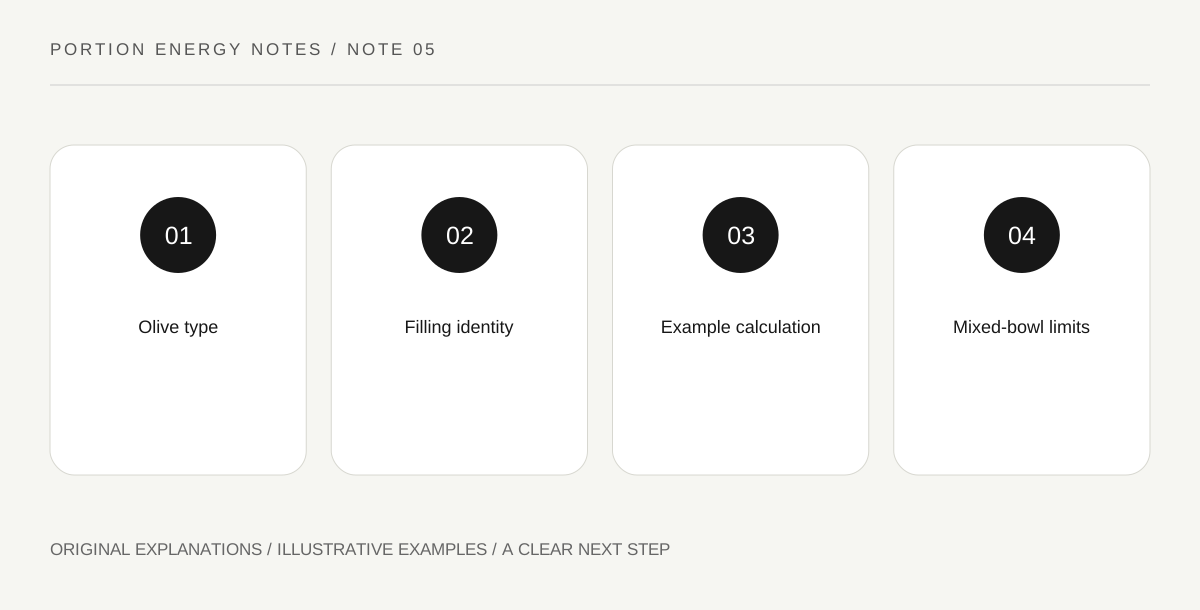
Original explanatory diagram. Read the full method and limitations below.
Read ripe and green as specific descriptions
SR Legacy record 169094 is ripe canned olives in the small-to-extra-large category, at 116 kcal per 100 g. Record 169096 is green olives, pickled, canned or bottled, at 145 kcal per 100 g. The names describe different reference foods. Keep the type with the number rather than creating one universal olive figure. A color seen in a photograph may help identify a question, but it does not provide the complete product, preparation or ingredient information needed for a confident match.
Do not expand the entry to a stuffed product
An almond-stuffed, cheese-stuffed or otherwise filled olive includes a formulation question beyond plain olives. Read the actual product information when available. A filling is not invisible because it fits inside the olive’s outline. The original comparison task is to identify which pieces belong to the chosen reference and which require another source. Do not add an entire separate filling estimate if a current packaged value already describes the complete stuffed product; that would count the same material twice.
Use a defined example for each type
For a hypothetical 30 g amount matching the green reference, 145 times 0.3 gives 43.5 kcal. For 30 g matching the specified ripe-canned reference, 116 times 0.3 gives 34.8 kcal. These calculations do not tell you the energy of an unknown mixed bowl. If you do not know its composition, retain that uncertainty rather than selecting the smaller result as the bowl’s answer. Neither 30 g amount is a recommended serving or a limit; it is simply the same mass used to demonstrate two inputs.
Keep the food’s role broader than its energy
Olives may be a seasoning component, part of a snack or one ingredient in a dish. The calorie value does not settle sodium content, allergy suitability for fillings or whether a meal has enough food. Use the relevant current label or nutrient information for those separate questions. A practical handover note can name the types in a mixed bowl and identify which package information belongs to each. That is more informative than a single exact-looking total based on an assumed uniform ingredient.
Illustrative worked example
Illustrative serving bowl: A host combines plain green olives with a separately identified stuffed product. They retain both labels rather than calling the whole bowl plain olives. In a separate calculation, 30 g of the historic green reference yields 43.5 kcal. The scenario does not analyze the mixed bowl, guess the amount of filling or prescribe an olive portion for guests. It preserves the boundary between a known reference exercise and an uncertain prepared mixture.
Questions that come up
Can I use the plain entry for every stuffed olive?
Not automatically. Use information for the complete actual product or an appropriately scoped known formulation.
Does the calorie figure tell me sodium?
No. Energy and sodium are different data fields. Consult the relevant current product or nutrient information for that question.
References and scope
These sources support the factual background. Examples and exercises are original illustrative teaching material. References do not imply endorsement.
- USDA SR Legacy April 2018 CSV archive — Historic energy nutrient 1008 values per 100 g edible material, used by the local factual food reference.
- USDA SR Legacy 169096: Olives, pickled, canned or bottled, green — Historic reference: 145.0 kcal per 100 g; exact description Olives, pickled, canned or bottled, green. Values verified from downloaded USDA archive, not a current product assay.
- USDA SR Legacy 169094: Olives, ripe, canned (small-extra large) — Historic reference: 116.0 kcal per 100 g; exact description Olives, ripe, canned (small-extra large). Values verified from downloaded USDA archive, not a current product assay.