Use pesto as the sauce actually measured, not as a synonym for basil
A pesto calorie value describes a prepared sauce, not just the green herb that makes it recognizable. USDA’s historic refrigerated ready-to-serve pesto entry gives one reference. Read it alongside a named salsa entry to understand food roles without assuming that all green or spooned sauces have the same formulation or purpose.
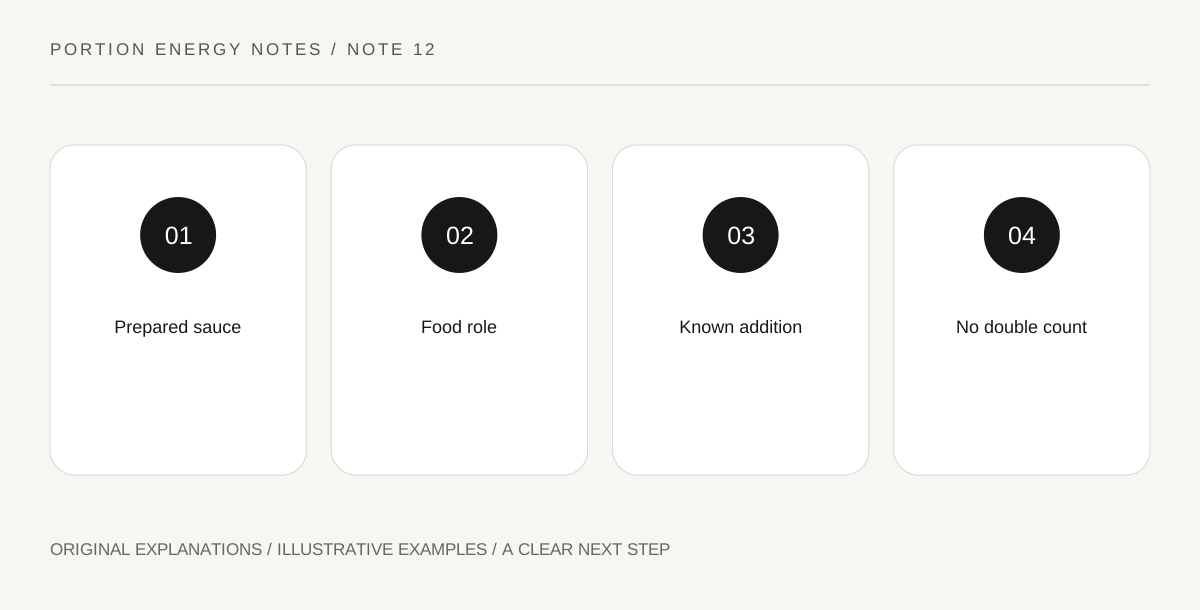
Original explanatory diagram. Read the full method and limitations below.
Read the ready-to-serve description
SR Legacy record 171579 is ready-to-serve refrigerated pesto at 418 kcal per 100 g. Keep refrigerated and ready-to-serve with that input. A dry seasoning mix, a homemade herb paste and a current jar of pesto can differ. The reference does not identify every product sold today. A useful kitchen note preserves the actual jar or recipe when available rather than replacing its full identity with basil, which names only one possible part of a much more complex food.
Keep a comparator’s role clear
Record 174524 is ready-to-serve salsa at 29 kcal per 100 g. That figure describes a different sauce. The contrast does not establish that salsa performs pesto’s job in every dish or that one should always replace the other. A pasta sauce, a sandwich spread and a topping can need different textures and flavors. The original planning question is what the sauce is doing in the food, followed by which actual evidence describes it. A lower number is not a complete cooking instruction.
Scale the chosen ingredient instead of its visual streak
For a hypothetical 15 g amount of the pesto reference, 418 times 0.15 gives 62.7 kcal. A green streak across a plate is not enough to infer 15 g, and a spoon’s shape does not establish the same mass for every sauce. Keep the example’s mass explicitly hypothetical unless the actual amount is known. The result is a reference calculation, not a claim about a photographed dish or a prescribed amount of pesto to use at dinner.
Avoid counting the same sauce twice
If a supplied complete-food value already includes pesto, do not add another pesto estimate merely because the sauce is visible. If the task concerns a separately added known ingredient, preserve that boundary instead. Ingredient suitability also needs actual product information; a sauce’s energy cannot determine whether it contains cheese, nuts or another relevant ingredient. A practical comparison can say what is known about the sauce and where its information came from, while leaving an unknown restaurant formulation visibly unresolved.
Illustrative worked example
Illustrative sandwich note: A cook adds an identified pesto separately and keeps that ingredient distinct from the bread and filling. A fictional 15 g calculation using the historic 418 kcal reference gives 62.7 kcal. Elsewhere, a packaged pesto sandwich already has complete-product information, so the cook does not add pesto again. The scenario does not prescribe 15 g, infer a photographed smear’s mass or claim that salsa is an equivalent recipe replacement.
Questions that come up
Can basil leaves use the pesto value?
No. A prepared sauce and an herb are different foods. Match the actual ingredient or formulation.
Does a complete pesto-pasta value need extra pesto added?
Only if a known separate addition lies outside that value. Check the information’s scope to avoid counting included sauce twice.
References and scope
These sources support the factual background. Examples and exercises are original illustrative teaching material. References do not imply endorsement.
- USDA SR Legacy April 2018 CSV archive — Historic energy nutrient 1008 values per 100 g edible material, used by the local factual food reference.
- USDA SR Legacy 171579: Sauce, pesto, ready-to-serve, refrigerated — Historic reference: 418.0 kcal per 100 g; exact description Sauce, pesto, ready-to-serve, refrigerated. Values verified from downloaded USDA archive, not a current product assay.
- USDA SR Legacy 174524: Sauce, salsa, ready-to-serve — Historic reference: 29.0 kcal per 100 g; exact description Sauce, salsa, ready-to-serve. Values verified from downloaded USDA archive, not a current product assay.