Keep miso paste separate from the soup it seasons
A tub of miso paste and a bowl of miso soup are different reference foods. The paste supplies an ingredient, while the finished bowl includes liquid and often other foods. USDA’s historic miso entry can support a scoped ingredient calculation, but it should not be assigned unchanged to every gram of a prepared soup.
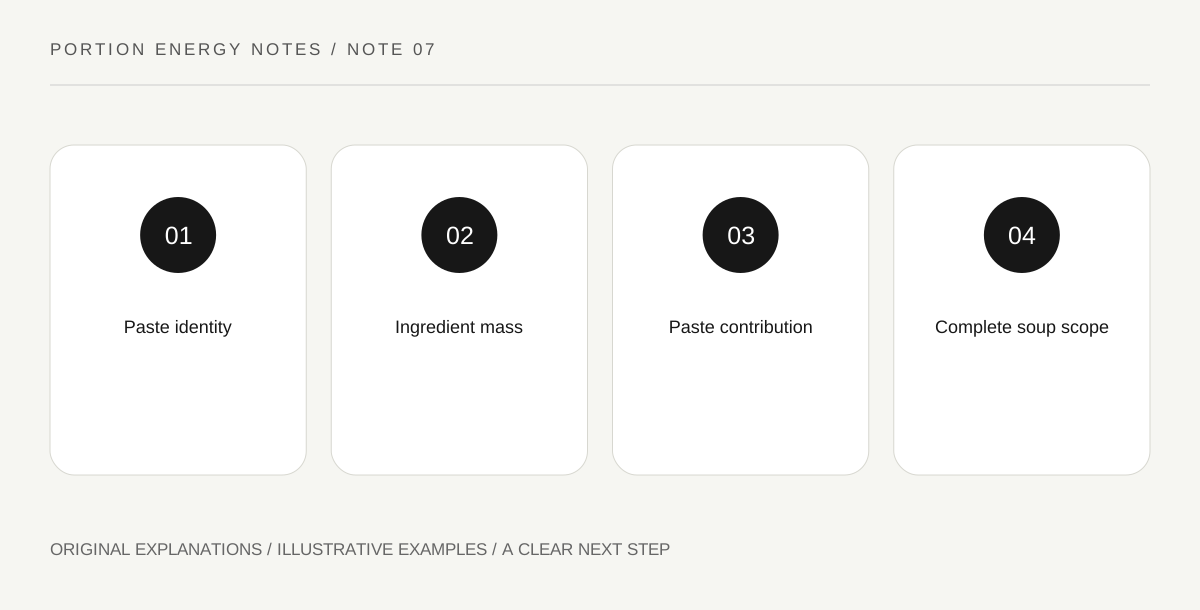
Original explanatory diagram. Read the full method and limitations below.
Read paste as the reference object
SR Legacy record 172442 is miso at 198 kcal per 100 g. It is not a ready-to-drink soup record. Keep that identity attached to the number. A search result shortened to miso can otherwise invite someone to multiply a whole soup bowl’s mass by the paste value. The mathematical operation may be correct while the food match is wrong. Begin by asking whether the measured material is concentrated paste, a prepared product or the complete finished bowl.
Name the other soup components
A bowl may include tofu, seaweed, vegetables, noodles or other ingredients. Those do not disappear into the word miso. For a known recipe, preserve what was actually added and use a coherent estimate for that formulation. For a packaged instant soup, the product’s own relevant information may describe the complete prepared serving. Avoid adding a separate paste estimate on top if the supplied complete-product value already includes it. The task is to keep the calculation’s scope consistent, not to count every recognizable ingredient twice.
Calculate the paste contribution only when that is the task
For an illustrative 12 g of the historic paste reference, 198 times 0.12 gives 23.76 kcal. That result describes the selected paste contribution. It does not describe an entire bowl unless the rest of the known formulation has also been considered appropriately. Adding water changes the mixture’s mass, but it does not mean the paste’s ingredient contribution should be multiplied by the finished bowl weight. Keep paste mass and soup mass as different named quantities in the note.
Choose a reference before discussing another nutrient
Miso often raises questions beyond food energy. This profile does not calculate sodium or determine a suitable personal intake. Use the actual product’s relevant nutrient information for those questions and seek individual guidance when needed. Different miso types and formulations can also differ from the historic generic reference. A useful kitchen handover identifies the tub or recipe and the ingredient quantity used, rather than offering a precise-looking soup total based only on its name and the size of the bowl.
Illustrative worked example
Illustrative soup worksheet: A cook knows that a fictional recipe uses 12 g of the selected miso reference, so they record 23.76 kcal as that ingredient’s contribution. Tofu and other additions remain separate known components. The final bowl mass is not substituted for the paste mass. The exercise does not analyze an unknown restaurant soup, prescribe miso use or infer sodium from the energy figure.
Questions that come up
Can I multiply the whole soup weight by 198 kcal per 100 g?
Only if the measured material actually matches that paste record, which a complete diluted soup does not. Choose the appropriate food or formulation.
Does 23.76 kcal answer the soup’s sodium question?
No. It is an energy calculation for a named ingredient amount. Sodium needs its own relevant data and context.
References and scope
These sources support the factual background. Examples and exercises are original illustrative teaching material. References do not imply endorsement.
- USDA SR Legacy April 2018 CSV archive — Historic energy nutrient 1008 values per 100 g edible material, used by the local factual food reference.
- USDA SR Legacy 172442: Miso — Historic reference: 198.0 kcal per 100 g; exact description Miso. Values verified from downloaded USDA archive, not a current product assay.