Give falafel a finished-food reference rather than a raw bean value
Falafel and hummus can share familiar ingredients while remaining different prepared foods. A calorie reference needs to describe the finished object being considered. USDA’s historic home-prepared falafel entry supports a specific example, while the hummus entry helps show why a common ingredient does not make two dishes interchangeable in a calculation.
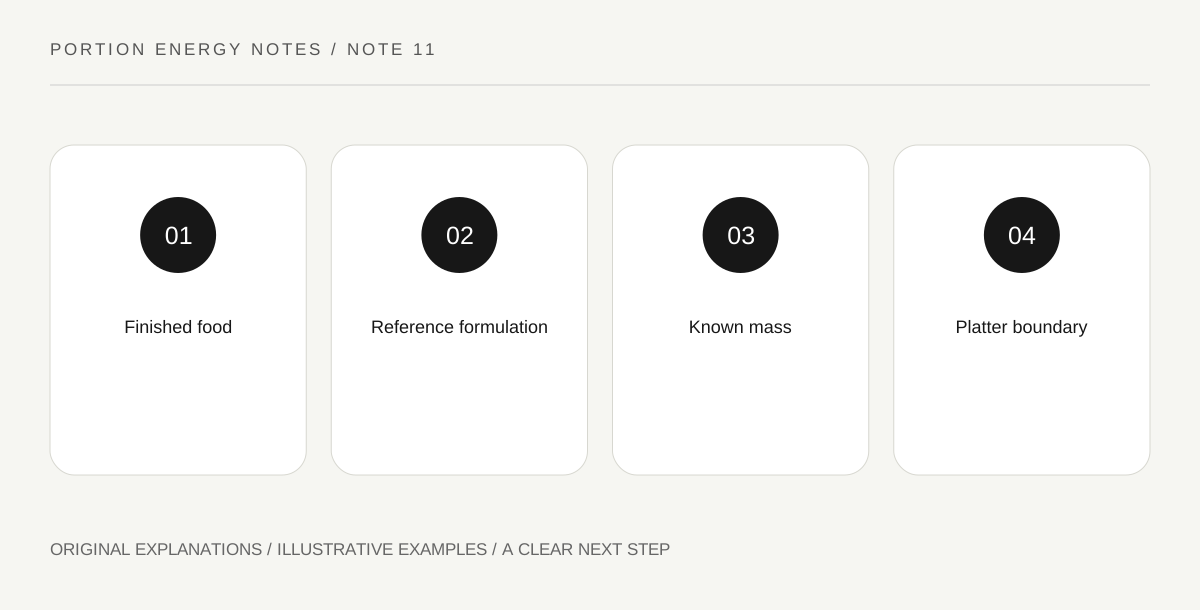
Original explanatory diagram. Read the full method and limitations below.
Keep home-prepared in the falafel description
SR Legacy record 172455 is home-prepared falafel at 333 kcal per 100 g. It is a reference formulation, not a measurement of every restaurant ball or homemade recipe. The entry’s name should remain attached to the value. A recipe made with a different legume mixture or cooking process can differ. Avoid treating the general word falafel as though it identifies one laboratory-standard product with a fixed weight and composition wherever it appears.
Do not use the bean ingredient as the finished result
A falafel mixture has preparation and ingredient questions beyond a plain bean record. A raw or cooked chickpea value cannot automatically describe the complete finished food. Likewise, the hummus home-prepared entry 172454 is 177 kcal per 100 g and represents a different prepared mixture. The shared association with chickpeas does not make the lower hummus value a substitute for falafel. Choose evidence based on the food that exists, not the ingredient whose name seems most familiar or the number that is easiest to remember.
Keep a piece count out of the reference unless known
For a hypothetical 45 g amount matching the falafel reference, 333 times 0.45 gives 149.85 kcal. That is a mass-based example, not a claim that one falafel weighs 45 g. A small flattened patty, a dense ball and a large restaurant piece can have different masses. If only a count is known, state what remains uncertain rather than assigning a universal per-piece value. The arithmetic cannot supply a missing piece weight or validate a match to an unknown restaurant preparation.
Separate the platter from the falafel itself
Bread, sauce, salad and other accompaniments form a meal beyond the named reference. A complete prepared-platter value may already include some of them, while a falafel-only entry does not. Keep the chosen scope coherent. The example does not instruct a person to remove bread or sauce, choose the smallest piece or compensate for the food’s energy. It helps describe an actual meal honestly, using known information and retaining uncertainty where the preparation or ingredient amounts are not available.
Illustrative worked example
Illustrative platter record: A reader has an identifiable falafel component and separate bread and sauce. They keep those components distinct rather than calling the whole platter falafel. In a fictional reference exercise, 45 g at 333 kcal per 100 g gives 149.85 kcal. That amount is not assigned to a real piece without evidence, and it is not recommended as a serving. No cooking-oil absorption or restaurant recipe is invented.
Questions that come up
Does one falafel always equal the example weight?
No. The example uses hypothetical grams. Piece size and density vary, so a count needs additional information.
Can I add bread to a value that already describes a whole sandwich?
Check the scope first. Adding included components again would double count them; a falafel-only value has a different boundary.
References and scope
These sources support the factual background. Examples and exercises are original illustrative teaching material. References do not imply endorsement.
- USDA SR Legacy April 2018 CSV archive — Historic energy nutrient 1008 values per 100 g edible material, used by the local factual food reference.
- USDA SR Legacy 172455: Falafel, home-prepared — Historic reference: 333.0 kcal per 100 g; exact description Falafel, home-prepared. Values verified from downloaded USDA archive, not a current product assay.
- USDA SR Legacy 172454: Hummus, home prepared — Historic reference: 177.0 kcal per 100 g; exact description Hummus, home prepared. Values verified from downloaded USDA archive, not a current product assay.