Give hummus its own reference instead of calling it plain chickpeas
Hummus is a prepared food, so its calorie reference describes more than chickpeas alone. USDA’s historic dataset includes both home-prepared and commercial entries. Read those as particular mixtures, not competing verdicts on homemade food, and keep the actual product or recipe visible when choosing an input for a calculation.
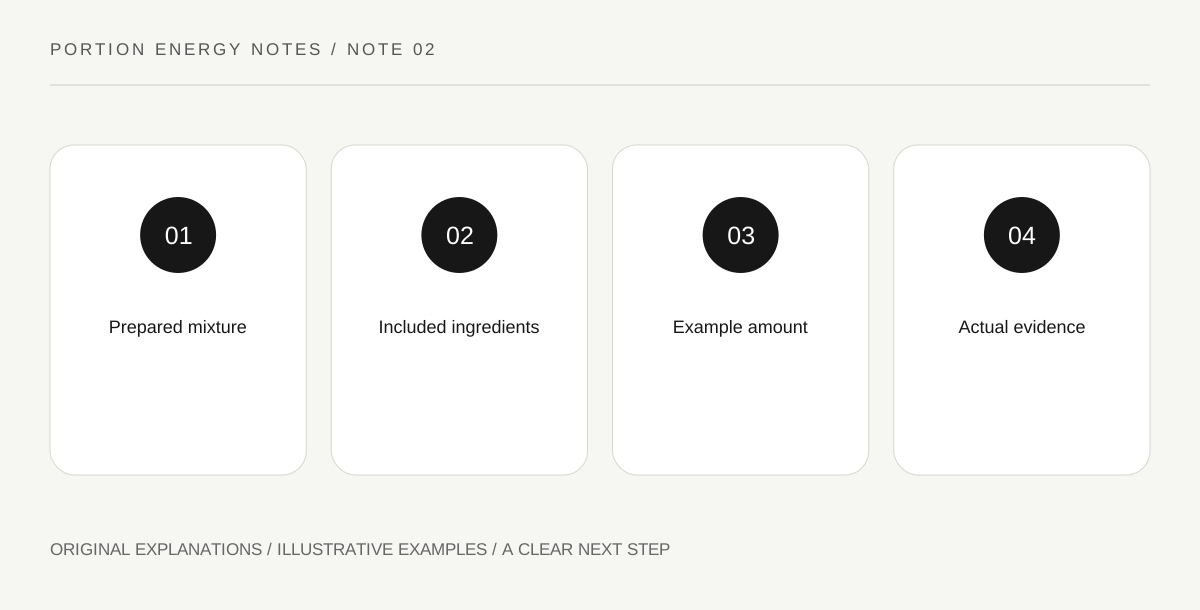
Original explanatory diagram. Read the full method and limitations below.
Identify the prepared mixture
SR Legacy record 172454 is hummus, home prepared, at 177 kcal per 100 g. Record 174289 is hummus, commercial, at 237 kcal per 100 g. Each value belongs to that named reference. Neither establishes the energy of every hummus sold or made today. A homemade bowl can use different ingredient proportions from the historic entry, and commercial formulations also vary. The first matching question is the whole prepared food, rather than the calorie value of its most prominent ingredient.
Read additions as ingredients rather than decorations
A topping swirl, extra oil, seeds or another addition may sit outside the base product’s reference. Determine whether it is included in the actual information you are using before accounting for it separately. This profile does not invent how much oil a dip absorbed or assume every hummus contains identical ingredients. The useful kitchen record distinguishes the base mixture from a later topping. That prevents both omitting an addition and counting an ingredient twice when it already belongs in a supplied product value.
Compare a defined amount without recommending it
For a fictional 40 g amount, the home-prepared reference gives 177 times 0.4, or 70.8 kcal. The commercial reference gives 237 times 0.4, or 94.8 kcal. The 24 kcal arithmetic difference applies to those inputs and that example weight. It is not a measured difference between two bowls on your table, a reason to reduce a meal or evidence that all homemade hummus is lower in energy. Keep the calculation as a transparent reference exercise.
Choose evidence for the actual bowl
For a current packaged hummus, use its own relevant label information. For a known homemade recipe, an appropriate ingredient-based estimate can describe that formulation, with assumptions visible. Do not retain the generic number simply because it is easier to remember. Energy also cannot determine whether the dip meets an allergy requirement; read its actual ingredients and the individual’s needs. A practical comparison can end with an unresolved match rather than assigning false precision to a bowl whose composition is unknown.
Illustrative worked example
Illustrative dip note: A host separates a plain packaged hummus from an oil-and-seed topping added at serving. They use the actual product information for the base and preserve the topping as a separate known addition. In a different arithmetic exercise, 40 g of the historic 177 kcal reference gives 70.8 kcal. These are separate scoped tasks, not a claim that the host’s bowl was analyzed or that 40 g is an appropriate serving for every guest.
Questions that come up
Is the homemade record a guarantee about my recipe?
No. It describes a historic reference formulation. Your actual ingredient proportions can differ.
Should I count both chickpeas and the complete hummus entry?
Not for the same material. Choose a coherent scope: a whole prepared-food value or an appropriate ingredient calculation, avoiding double counting.
References and scope
These sources support the factual background. Examples and exercises are original illustrative teaching material. References do not imply endorsement.
- USDA SR Legacy April 2018 CSV archive — Historic energy nutrient 1008 values per 100 g edible material, used by the local factual food reference.
- USDA SR Legacy 172454: Hummus, home prepared — Historic reference: 177.0 kcal per 100 g; exact description Hummus, home prepared. Values verified from downloaded USDA archive, not a current product assay.
- USDA SR Legacy 174289: Hummus, commercial — Historic reference: 237.0 kcal per 100 g; exact description Hummus, commercial. Values verified from downloaded USDA archive, not a current product assay.
- FDA: Food-allergy label reading — Read actual ingredient information for allergy decisions; energy values do not establish ingredient suitability.