Keep sauerkraut’s solids-and-liquids wording in the note
A sauerkraut reference can explicitly describe both solids and liquid, while a serving in the kitchen may be handled differently. USDA’s historic canned entry makes that boundary visible. Read it carefully, and compare it with kimchi only as another named food rather than assuming every fermented cabbage preparation has one shared composition.
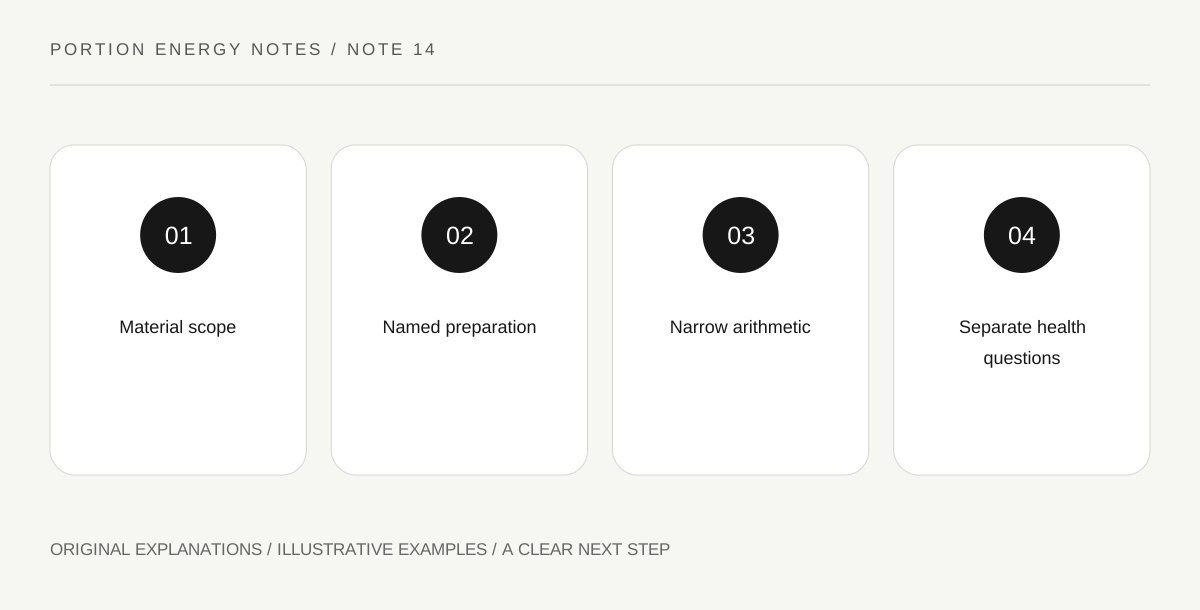
Original explanatory diagram. Read the full method and limitations below.
Read the sauerkraut record’s material
SR Legacy record 169279 is canned sauerkraut, solids and liquids, at 19 kcal per 100 g. Keep solids and liquids with the figure. It does not automatically describe a carefully drained forkful or a cooked dish containing sauerkraut and other ingredients. A calculation should state what material its weight refers to. Do not invent a drainage correction or claim that a particular squeeze removes a known amount of energy when no such measurement or matching data is available.
Give kimchi a separate reference
Record 170392 is cabbage kimchi at 15 kcal per 100 g. That historic generic description is not a universal value for every kimchi recipe, vegetable or current package. Different prepared foods deserve their own identities even when both are associated with cabbage and fermentation. The comparison does not require choosing a winner. It shows why a broad category such as fermented vegetables is too general to serve as the complete food description for a specific energy calculation.
Calculate a narrow example honestly
For a fictional 50 g amount matching the canned sauerkraut solids-and-liquids entry, 19 times 0.5 gives 9.5 kcal. The same hypothetical mass matching the selected cabbage-kimchi reference gives 7.5 kcal. These are values for two defined reference exercises. The 2 kcal arithmetic difference is not a precise measured difference between two actual servings, and it does not justify interpreting the products as nutritionally identical. Unknown formulations and handling remain outside the arithmetic’s ability to resolve.
Keep fermentation claims outside an energy-only result
This profile does not establish live-culture content, a microbiome benefit, sodium suitability or a personal amount to eat. Use the actual product information and appropriate evidence for those separate questions. A canned product name and a generic calorie value cannot answer all of them. For a dish with added meat, oil or other foods, select a coherent complete-dish source or known formulation instead of treating the visible cabbage as the whole meal. The useful reference preserves scope and uncertainty without promising health effects.
Illustrative worked example
Illustrative pantry note: A cook records that the selected sauerkraut reference includes solids and liquids. Their actual dish uses a different handling method, so they do not claim an exact match without further information. A separate 50 g reference exercise yields 9.5 kcal. The scenario does not prescribe 50 g, invent a draining coefficient or infer a probiotic effect from the food’s name.
Questions that come up
Can I correct the number by guessing how much liquid was squeezed out?
Do not invent a correction. Use a suitable matching source or clearly state the limitation of the available reference.
Does the calorie entry prove live cultures are present?
No. Energy data do not establish culture content or a health effect. Those questions require different evidence.
References and scope
These sources support the factual background. Examples and exercises are original illustrative teaching material. References do not imply endorsement.
- USDA SR Legacy April 2018 CSV archive — Historic energy nutrient 1008 values per 100 g edible material, used by the local factual food reference.
- USDA SR Legacy 169279: Sauerkraut, canned, solids and liquids — Historic reference: 19.0 kcal per 100 g; exact description Sauerkraut, canned, solids and liquids. Values verified from downloaded USDA archive, not a current product assay.
- USDA SR Legacy 170392: Cabbage, kimchi — Historic reference: 15.0 kcal per 100 g; exact description Cabbage, kimchi. Values verified from downloaded USDA archive, not a current product assay.