Keep sweet pickles and dill pickles as separate reference foods
Pickled cucumber is not one uniform calorie reference. A sweet preparation and a dill preparation have distinct historic USDA entries. Read the descriptors before comparing them, then keep energy separate from sodium, taste and the amount that belongs in a person’s meal. A small condiment can still deserve an accurate food name.
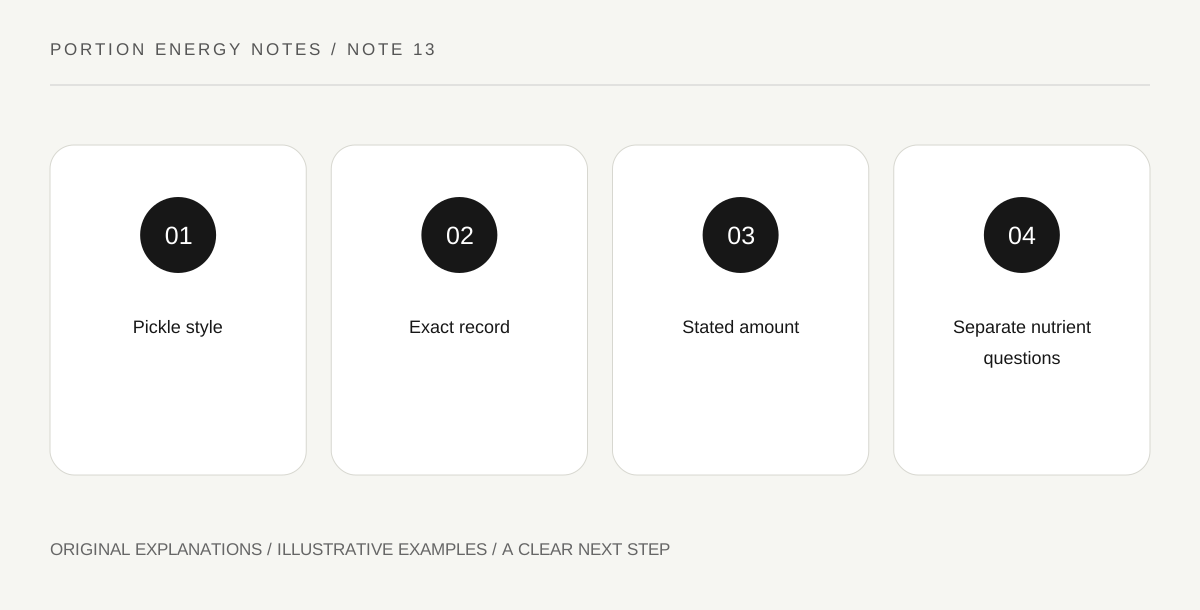
Original explanatory diagram. Read the full method and limitations below.
Read the sweet entry in full
SR Legacy record 169378 is sweet cucumber pickles, including bread-and-butter pickles, at 91 kcal per 100 g. The description matters more than a generic pickle photograph. A sliced sweet product is not automatically the same formulation as another jar with a similar label, and a current product’s own information can be more specific. Keep the actual preparation name in a reference note so a later reader does not assume the number applies to every preserved cucumber.
Give dill its own identity
Record 168558 is dill or kosher-dill cucumber pickles at 12 kcal per 100 g. That is a different reference. Kosher dill in the food description does not by itself answer every certification or individual dietary question about a current product. Read the actual package for the question being asked. Do not treat the lower energy as proof that the product is lower in sodium or that a particular jar contains no ingredients of concern. Those require their own information.
Use a comparison with a stated material
For separate hypothetical 25 g amounts of the described pickle foods, the sweet reference gives 22.75 kcal and the dill reference gives 3 kcal. These are arithmetic results for the selected inputs. They do not establish the value of an unknown forkful, a jar including all its liquid or a restaurant side. Keep the actual food material and record description aligned. The 25 g amount is neither a serving recommendation nor a restriction; it simply allows a transparent equal-mass reference exercise.
Preserve the food’s place in the dish
Pickles may be part of a sandwich, chopped into a dressing or served separately. If a complete product value already includes them, another pickle estimate can duplicate an ingredient. If they are a separate known addition, identify that scope. The purpose is a reconstructable description, not a reason to remove an enjoyable condiment or label sweet foods as a moral failure. A useful food-energy reference can acknowledge formulation differences without turning a jar comparison into personal diet advice.
Illustrative worked example
Illustrative label review: A reader notices that one historic result says sweet and another says dill. They retain both names and calculate 22.75 kcal and 3 kcal for separate fictional 25 g amounts. They do not infer sodium from those results and use the current jar’s information for an actual product. The scenario neither analyzes a restaurant sandwich nor recommends a particular amount of pickles.
Questions that come up
Can I use the dill entry for bread-and-butter pickles?
Not as an automatic match. The historic sweet entry explicitly includes bread-and-butter pickles and has a different reference value.
Does lower calorie mean lower sodium?
No. Energy and sodium are separate properties. Read the relevant product or nutrient information for sodium.
References and scope
These sources support the factual background. Examples and exercises are original illustrative teaching material. References do not imply endorsement.
- USDA SR Legacy April 2018 CSV archive — Historic energy nutrient 1008 values per 100 g edible material, used by the local factual food reference.
- USDA SR Legacy 169378: Pickles, cucumber, sweet (includes bread and butter pickles) — Historic reference: 91.0 kcal per 100 g; exact description Pickles, cucumber, sweet (includes bread and butter pickles). Values verified from downloaded USDA archive, not a current product assay.
- USDA SR Legacy 168558: Pickles, cucumber, dill or kosher dill — Historic reference: 12.0 kcal per 100 g; exact description Pickles, cucumber, dill or kosher dill. Values verified from downloaded USDA archive, not a current product assay.